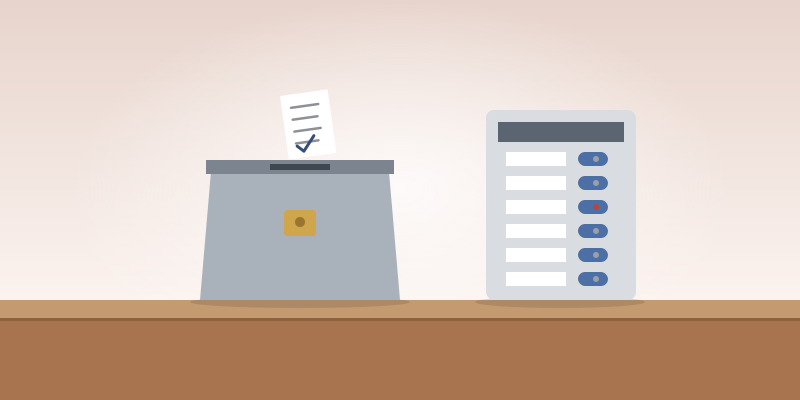
India's first general election was held over about four months, from 25 October 1951 to 21 February 1952, with around 173 million eligible voters, most of whom could not read; parties were identified by symbols and each candidate had a separate ballot box. Chief Election Commissioner Sukumar Sen conducted it.
About 173 million eligible voters.
Quick check: Who conducted India's first general election?
B.N. Rau
T.N. Seshan
Sukumar Sen
Jawaharlal Nehru
Answer: C.
1950 and 1951
The Representation of the People Acts
The election code
The Representation of the People Act 1950 deals with the allocation of seats, delimitation and electoral rolls; the 1951 Act governs the conduct of elections, qualifications and disqualifications, corrupt practices and election disputes.
1950 Act: seats and electoral rolls.
1951 Act: conduct of elections and disputes.
Quick check: Which Act governs corrupt practices and election disputes?
Election Commission Act, 2023
Representation of the People Act, 1950
Representation of the People Act, 1951
Delimitation Act, 2002
Answer: C.
1960 onwards
The Model Code of Conduct
Not a law, but enforced
The Model Code of Conduct is a set of guidelines for parties and candidates during elections, which comes into force when the election schedule is announced. It began in Kerala in 1960 and was adopted nationally over time. It has no statutory basis but is enforced by the Election Commission, most famously by T.N. Seshan in the 1990s.
First used in Kerala, 1960.
Not a statute.
Quick check: Does the Model Code of Conduct have statutory backing?
Yes, under the Election Commission Act 2023
Yes, under Article 324
No, it is a set of guidelines enforced by the ECI
Yes, under the RP Act 1951
Answer: C.
1982 onwards
Electronic Voting Machines
From Paravur to every booth
EVMs were first used in part of the Paravur assembly constituency in Kerala in a 1982 by-election. In A.C. Jose v. Sivan Pillai (1984) the Supreme Court set aside that election because the law did not then provide for EVMs; Parliament added Section 61A to the RP Act in 1988. EVMs were used in all constituencies from 2004.
First used in Paravur, Kerala (1982).
Section 61A added to the RP Act in 1988.
Quick check: Where were EVMs first used in an Indian election?
Paravur, Kerala
Bhopal, Madhya Pradesh
Noksen, Nagaland
Gandhinagar, Gujarat
Answer: A.
2013 onwards
VVPAT
A paper trail for EVMs
Voter Verifiable Paper Audit Trail machines, which print a slip the voter can see, were first used in the Noksen assembly constituency in Nagaland in 2013, after the Supreme Court in Subramanian Swamy v. ECI (2013) called a paper trail an indispensable requirement of free and fair elections. In 2024 the Supreme Court rejected pleas for 100% counting of VVPAT slips.
First used in Noksen, Nagaland (2013).
Quick check: Where were VVPATs first used?
Paravur, Kerala
Noksen, Nagaland
Panaji, Goa
Varanasi, UP
Answer: B.
48 more entries under this heading
NOTA · None of the Above
Candidates' Disclosure of Criminal Records and Assets · Voters' right to know
Abhiram Singh v. C.D. Commachen · No votes in the name of religion
Party Symbols · The Symbols Order
The Special Intensive Revision of Electoral Rolls · Bihar and beyond
Election Petitions · Challenging an election
Disqualification of Legislators · Office of profit and more
CEC: Sukumar Sen · Conducted the first two general elections
CEC: K.V.K. Sundaram · The second Chief Election Commissioner
CEC: S.P. Sen Verma · Conducted the 1971 mid-term election
CEC: Nagendra Singh · Later President of the International Court of Justice
CEC: T. Swaminathan · CEC during the Emergency and the 1977 election
CEC: S.L. Shakdher · A former Secretary-General of the Lok Sabha
CEC: R.K. Trivedi · CEC when EVMs were first tried
CEC: R.V.S. Peri Sastri · CEC when the Commission first became multi-member
CEC: V.S. Ramadevi · The first woman Chief Election Commissioner
CEC: T.N. Seshan · Made the Model Code of Conduct bite
CEC: M.S. Gill · Later a Union Minister
CEC: J.M. Lyngdoh · Held the 2002 Gujarat and Jammu and Kashmir elections
CEC: T.S. Krishnamurthy · The first all-EVM general election
CEC: B.B. Tandon · Succeeded T.S. Krishnamurthy
CEC: N. Gopalaswami · Recommended the removal of his fellow Commissioner
CEC: Navin Chawla · Conducted the 2009 general election
CEC: S.Y. Quraishi · The first Muslim Chief Election Commissioner
CEC: V.S. Sampath · Conducted the 2014 general election, with NOTA
CEC: H.S. Brahma · The first CEC from the Northeast
CEC: Nasim Zaidi · Oversaw the EVM "hackathon" challenge
CEC: A.K. Joti · A former Chief Secretary of Gujarat
CEC: O.P. Rawat · Served for most of 2018
CEC: Sunil Arora · Conducted the 2019 general election
CEC: Sushil Chandra · A former chair of the CBDT
CEC: Rajiv Kumar · Conducted the 2024 general election
CEC: Gyanesh Kumar · The first CEC appointed under the 2023 selection law
Mohinder Singh Gill v. Chief Election Commissioner · Article 324 gives the Commission plenary but not arbitrary powers
T.N. Seshan v. Union of India · The multi-member Election Commission upheld
Anoop Baranwal v. Union of India · The CJI was added to the committee that selects election commissioners
Chief Election Commissioner and Other Election Commissioners Act 2023 · The first law on how election commissioners are appointed
Delimitation Commissions · Four commissions have redrawn India's constituencies
The Freeze on Lok Sabha Seats · Seat allocation among states is frozen until after the first census after 2026
Voting Age Lowered to 18 · The 61st Amendment reduced the voting age from 21 to 18
Indelible Ink · Made by Mysore Paints and Varnish Limited
Electors Photo Identity Cards · Introduced by T.N. Seshan
Shyam Saran Negi, India's First Voter · Cast the first vote of independent India
Tashigang Polling Station · The world's highest polling station
The One-Voter Polling Booth in Gir · A polling station for a single voter
National Voters' Day · Marks the founding of the Election Commission
The 2024 General Election · The largest election in history
VVPAT First Used · Paper trails began in Nagaland
PlusAll 53 entries, and every heading in the LibraryYours from ₹1,499, till CLAT 2028See Plus