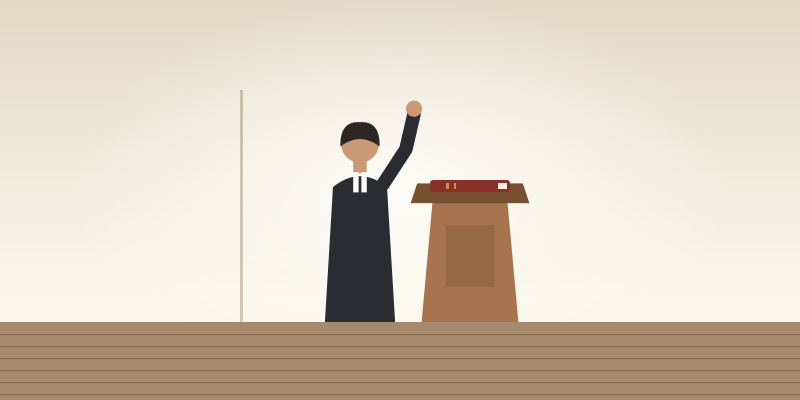
In January 1909, while Vallabhbhai Patel was cross-examining a witness in a murder trial at Anand, he was handed a telegram. He read it, put it in his pocket and finished the cross-examination. Only afterwards did he tell those around him that it reported the death of his wife, Jhaverba, in a Bombay hospital. The story, told by his biographers, became part of his legend of iron will.
His wife Jhaverba died in 1909.
Quick check: What news did the telegram handed to Sardar Patel in court in 1909 bring?
His father's arrest
News of the Kheda famine
His appointment as a judge
The death of his wife
Answer: D.
Legend
"The Examinee Is Better Than the Examiner"
Rajendra Prasad's answer sheet
A popular legend says that an examiner wrote on one of Rajendra Prasad's answer sheets at Calcutta University, "The examinee is better than the examiner." Prasad was indeed an outstanding student who topped the university's entrance examination, but the story of the remark has never been documented and should be treated as a legend.
1976
Khanna's Words to His Sister
"It is going to cost me the Chief Justiceship"
Justice H.R. Khanna later recounted that before delivering his dissent in ADM Jabalpur he told his sister that he had prepared a judgment that was going to cost him the Chief Justiceship of India. In January 1977 he was superseded and resigned.
Quick check: According to his own account, what did Justice Khanna expect his ADM Jabalpur dissent to cost him?
His licence to practise
The Chief Justiceship of India
His seat in Parliament
His Padma award
Answer: B.
24 June 1975
The Vacation Judge and the Prime Minister
Krishna Iyer's conditional stay
After the Allahabad High Court set aside Indira Gandhi's election, her appeal came before Justice V.R. Krishna Iyer as the Supreme Court's vacation judge. On 24 June 1975 he granted only a conditional stay: she could remain Prime Minister and attend Parliament, but could not vote or draw a salary as an MP. The Emergency was proclaimed the next night.
Conditional stay on 24 June 1975.
Emergency proclaimed on the night of 25 June 1975.
Quick check: Which judge granted Indira Gandhi only a conditional stay on 24 June 1975?
Y.V. Chandrachud
H.R. Khanna
V.R. Krishna Iyer
A.N. Ray
Answer: C.
1975
Only the Judge Rises
The Prime Minister in the witness box
When Indira Gandhi appeared as a witness in the Allahabad High Court in March 1975 — the first time a sitting Prime Minister testified in an Indian court — Justice Jagmohanlal Sinha is widely reported to have directed that no one should rise when she entered, since the courtroom rises only for the judge.
First sitting Prime Minister to testify in court.
24 April 1973
The "View by the Majority"
A controversial summary
At the end of Kesavananda Bharati, Chief Justice Sikri circulated a short summary, "View by the Majority", stating that Parliament could not alter the basic structure. It was signed by nine of the thirteen judges, although the individual opinions differed considerably, and scholars have long debated what exactly the majority held.
Signed by nine of the thirteen judges.
1940–2020
The Swami Behind the Case
Kesavananda Bharati
Swami Kesavananda Bharati, head of the Edneer Mutt in Kasaragod, Kerala, filed the petition challenging Kerala's land reform laws that became India's most famous constitutional case. He died in September 2020, aged 79.
Head of the Edneer Mutt, Kerala.
Died in September 2020.
Quick check: Swami Kesavananda Bharati was the head of which mutt?
Kanchi Mutt
Udupi Mutt
Edneer Mutt
Sringeri Mutt
Answer: C.
March 1931
Bhagat Singh's Last Demand
Shoot us like prisoners of war
Shortly before their execution, Bhagat Singh, Sukhdev and Rajguru wrote to the Governor of Punjab that, as they had been convicted of waging war against the King, they should be treated as prisoners of war and shot by a firing squad rather than hanged. The request was ignored.
1969
A Chief Justice Receives a US President
Acting President Hidayatullah
As acting President of India in July–August 1969, Chief Justice M. Hidayatullah received US President Richard Nixon on his visit to India — a Chief Justice receiving a visiting head of state as head of state.
Quick check: Which US President was received by Chief Justice Hidayatullah as acting President of India in 1969?
Richard Nixon
Gerald Ford
Lyndon B. Johnson
Dwight Eisenhower
Answer: A.
October 2019
The Torn Map
Drama in the Ayodhya hearing
On the last day of the Ayodhya hearings in October 2019, senior advocate Rajeev Dhavan, appearing for the Muslim parties, tore up a pictorial map that the other side tried to place on record, with the Chief Justice's leave. The moment made headlines across the country.
May 2018
The Court at 2 a.m.
Karnataka's floor test
After the Karnataka Governor invited B.S. Yediyurappa to form a government in May 2018, a three-judge bench of the Supreme Court sat through the night, from around 2 a.m., on a petition by the Congress and JD(S). It later ordered an early floor test, and Yediyurappa resigned before it.
20 March 2020
The Last-Night Hearing in the Nirbhaya Case
Hours before the hanging
In the early hours of 20 March 2020, a Supreme Court bench heard a last-minute plea from one of the Nirbhaya convicts and dismissed it; the four convicts were hanged at Tihar Jail at 5:30 a.m. that morning.
1891–1892
Gandhi Freezes in Court
The barrister who could not speak
In his first case, at a small causes court in Bombay, Gandhi rose to cross-examine a witness but could not think of a single question. He sat down, told the client's agent to engage another lawyer and returned his fee. He later called the experience a lesson that shaped his humility.
Bombay High Court
The Plaque in Courtroom 46
Tilak's words on the wall
The courtroom in the Bombay High Court where Tilak was convicted of sedition in 1908 carries a plaque with his words from the dock, that there are higher powers that rule the destiny of things, and that it may be the will of Providence that the cause he represents prospers more by his suffering than by his remaining free. The same court had once sent him to prison.
1940s
The Teenage Lawyer
Ram Jethmalani's exemption
Ram Jethmalani finished his law degree at 17. As the Bar rules then required advocates to be 21, he petitioned for an exemption, and a special resolution allowed him to start practising at 18.
2019
Standing at 92
Parasaran in the Ayodhya hearings
During the Ayodhya hearings in 2019, 92-year-old K. Parasaran argued standing for hours; when the Chief Justice offered him a chair, he is reported to have declined, saying that Indian tradition required him to stand while arguing before the court.
1950–1958
A Court in a Parliament
The Chamber of Princes
For its first eight years, the Supreme Court sat in the Chamber of Princes in Parliament House, where the Federal Court had sat before it. Judges' chambers were improvised in the building until the Tilak Marg building opened in 1958.
1916
Regina Guha's Case
Are women "persons"?
When Regina Guha applied to be enrolled as a pleader in 1916, a full bench of the Calcutta High Court held that the word "person" in the Legal Practitioners Act did not include women. It took the Legal Practitioners (Women) Act of 1923 to open the profession to women.
1975
Palkhivala Returns the Brief
He withdrew as Indira Gandhi's counsel after the Emergency
Nani Palkhivala had agreed to argue Indira Gandhi's appeal against the Allahabad verdict; after the Emergency and mass arrests, he returned the brief.
Quick check: When did this happen: Palkhivala Returns the Brief?
1858
1975
1970
1929
Answer: B.
1975
Nariman Resigns as Additional Solicitor General
He quit the day after the Emergency was declared
Fali S. Nariman resigned as Additional Solicitor General in protest on 26 June 1975, one of the few officials to do so.
Quick check: When did this happen: Nariman Resigns as Additional Solicitor General?
1975
1858
1970
1929
Answer: A.
1976
The New York Times on Justice Khanna
"Someone will surely erect a monument to Justice H.R. Khanna"
After his ADM Jabalpur dissent, a New York Times editorial said that if India ever found its way back to freedom and democracy, someone would surely erect a monument to him.
Quick check: When did this happen: The New York Times on Justice Khanna?
1976
1858
1929
1970
Answer: A.
1927
Ambedkar Burns the Manusmriti
A symbolic protest at Mahad
On 25 December 1927, during the Mahad Satyagraha, Ambedkar and his followers burned the Manusmriti; the day is marked as Manusmriti Dahan Din.
Quick check: When did this happen: Ambedkar Burns the Manusmriti?
1858
1970
1929
1927
Answer: D.
1929
Jinnah Defends the Hunger Strikers
A speech in the Central Legislative Assembly
Jinnah opposed a bill to allow trials in the absence of hunger-striking accused, defending Bhagat Singh and his comrades' right to be heard.
Quick check: When did this happen: Jinnah Defends the Hunger Strikers?
1970
1929
1685
1858
Answer: B.
1858
Lincoln and the Almanac
Moonlight and a murder trial
Defending Duff Armstrong, Abraham Lincoln used an almanac to show the moon was too low for a witness to have seen the crime as claimed.
Quick check: When did this happen: Lincoln and the Almanac?
1685
1970
1929
1858
Answer: D.
1970
Lord Denning's Opening Lines
"It happened on April 19, 1964. It was bluebell time in Kent."
Denning's judgments began like stories; this one, in Hinz v. Berry, is among the most quoted openings in English law.
Quick check: When did this happen: Lord Denning's Opening Lines?
1685
1858
1970
1929
Answer: C.
1685
Judge Jeffreys and the Bloody Assizes
The hanging judge of English legend
After Monmouth's Rebellion, Judge George Jeffreys sentenced hundreds to death or transportation, becoming a byword for judicial cruelty.
Quick check: When did this happen: Judge Jeffreys and the Bloody Assizes?